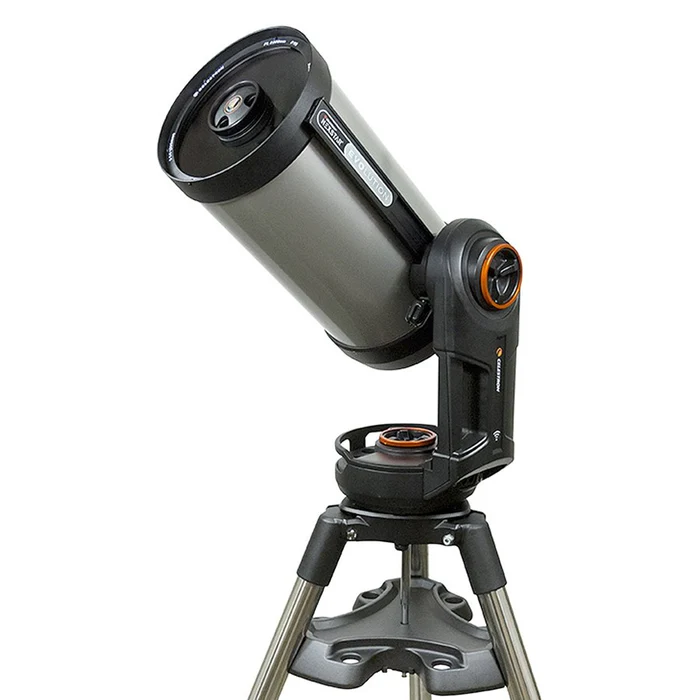
Celestron NexStar Evolution 9.25” Schmidt-Cassegrain Telescope
The 9.25-inch Schmidt-Cassegrain sits at the top of the NexStar Evolution line — 235mm of aperture, Celestron’s StarBright XLT coatings, and the same proven C9.25 optical tube design that’s been refined over decades of production. Paired with the Evolution mount’s integrated technology — a built-in lithium-iron phosphate battery, onboard WiFi, and the NexStar+ GoTo computer — it’s a capable all-in-one setup that doesn’t require an extension cord or an external power tank to work in the field.
For visual observing, the mount handles the load without difficulty — GoTo tracking is smooth, and the brass worm gears hold their accuracy. Where the single-arm fork shows its limits is in damping time after tapping the focuser, in wind, or when a heavy 2” accessory is attached. Near zenith with a 2” star diagonal, clearance between the focuser and the mount base is tight.
The step up from the 8” Evolution is real: 34% more light-collecting area, 16% more linear resolving power, a Dawes limit of 0.49 arc seconds versus 0.57, and 1,127x light-gathering advantage over the unaided eye. You see the difference on tight double stars, globular cluster resolution, the ring structure of planetary nebulae, and galaxy surface brightness. If those are your targets, the extra aperture earns its keep.
What’s in the Box
- Celestron C9.25 optical tube (235mm f/10 SCT, StarBright XLT coatings, CG-5 dovetail bar)
- Single-arm fork mount with integrated LiFePO4 battery and built-in WiFi
- 2” stainless steel adjustable tripod with accessory tray
- NexStar+ hand controller (40,000+ object database, backlit LCD, USB 2.0)
- 40mm Plössl eyepiece (59x)
- 13mm Plössl eyepiece (180x)
- Red dot finderscope
- 1.25” star diagonal
- Visual back
- AC adapter (4-plug)
- Celestron Starry Night Special Edition software
Features
-
235mm (9.25”) StarBright XLT Schmidt-Cassegrain Optics — Celestron’s StarBright XLT multi-layer coatings transmit up to 97.4% on the corrector lens and apply anti-reflection coatings to both mirrors, delivering maximum light throughput for this aperture. The C9.25 optical tube is Fastar compatible, meaning you can install the optional Hyperstar adapter to convert the scope to f/2 for ultra-fast wide-field imaging — a completely different operating mode from the standard f/10 visual configuration.
-
Built-In LiFePO4 Battery — A 9-cell 6V 4.5Ah lithium-iron phosphate pack is integrated into the mount head with no external battery tank required. Celestron rates it for up to 10 continuous hours of GoTo tracking under normal conditions. Real-world sessions at moderate temperatures confirm 8–10 hours of routine use. It recharges from the included AC adapter, from a 12V vehicle outlet, or via USB. Cold-weather observers should plan for 20–30% reduced capacity.
-
Integrated WiFi and SkyPortal App — The mount creates its own WiFi hotspot. Connect a smartphone or tablet, open the SkyPortal app, and you have GoTo control, real-time scope status, and access to a 120,000-object catalog — without pulling out the hand controller. SkyPortal is free on iOS and Android. The NexStar+ hand controller is still included and fully functional; the WiFi is additive, not a replacement.
-
NexStar+ GoTo with Brass Worm Gears — DC servo motors drive brass worm gears at nine selectable slew speeds up to 4° per second. Brass worms outlast plastic alternatives and maintain their accuracy over years of use. Seven alignment options are available including SkyAlign (identify any three bright objects — the scope figures out where it is), which means you can align without knowing the sky.
-
Alt-Az and EQ Tracking Modes — The default operating mode is Alt-Az, which is correct for visual observing and short-exposure imaging. Install an optional equatorial wedge and switch the firmware to EQ North or EQ South for long-exposure astrophotography. Both modes are built into the NexStar+ hand controller; no additional hardware modifications are required beyond the wedge.
-
Four Auxiliary Ports and Manual Clutch — Four AUX ports on the mount head accept Celestron accessories: motorized focusers, dew heater controllers, StarSense AutoAlign, and more. A manual clutch lets you move the tube by hand without engaging the motors — useful during initial setup and star-hopping when you want to point quickly without waiting on the GoTo system.
-
Height-Adjustable Stainless Steel Tripod — The 2” stainless steel tripod legs adjust from 49” to 65” height and support the full 62.6-pound kit weight without flex. The accessory tray locks the spread of the legs and holds eyepieces off the wet ground. The CG-5 saddle plate on the mount head accepts the CG-5 dovetail on the C9.25 OTA and is compatible with other CG-5-standard optical tubes.
Under the Night Sky
At 59x with the included 40mm eyepiece, the 9.25” SCT provides about 1° of true field — wide enough to frame the Orion Nebula in its full context, sweep along the Virgo galaxy chain, or show the Beehive Cluster with room to spare. The 13mm eyepiece at 180x is where planetary detail starts to emerge: Cassini’s Division in Saturn’s rings, cloud belt structure on Jupiter, polar ice on Mars at opposition, and the crescent phase of Venus.
Bump to 250x–350x in good seeing, and the 9.25” aperture starts to distinguish itself from the 8”. M13 in Hercules resolves to individual stars across most of the core. The Ring Nebula (M57) shows a distinct donut shape with a darker center. NGC 4565, the edge-on galaxy in Coma Berenices, shows a clean dark lane across the nucleus at 200x. Tight double stars like Porrima reach the edge of resolution, compared to the 8” which may or may not split it cleanly depending on conditions.
The 2350mm focal length is excellent for planets but can feel limiting on large nebulae. For objects like the North America Nebula or M31, the 40mm eyepiece gives you the widest field this scope will produce. For strictly visual wide-field work, a shorter-focal-length instrument may complement the 9.25” more than replace it.
What Cloudy Nights Members Say
“The optics on the C9.25 are exceptional — tight stars right to the edge with the right eyepiece, and planetary detail that made me retire my 8-inch. The mount tracks well enough for high-power observing. I use it strictly visual and haven’t hit any of the clearance issues people mention, because I just never go to zenith with a 2-inch diagonal.”
“I had an 8SE for years and the 9.25 Evolution is a meaningful upgrade. That extra inch and a quarter makes a difference on globulars and small planetary nebulae. The built-in battery is genuinely useful — I don’t miss hauling a gel-cell to my dark site.”
“For what I do — visual observing from the backyard, mostly planets and bright showpiece objects — this scope is excellent. I went in knowing the single-arm fork has limits compared to the CPC. Those limits haven’t been a problem for me. People who want to image long-exposure deep sky should look at the CPC or an EQ mount.”
Observing Tip
The C9.25 corrector plate is larger than the C8 and holds heat longer — budget 45–60 minutes for cool-down before pushing to high powers on planets, and you’ll be rewarded with steadier images. A shroud or dew heater on the corrector prevents fogging on humid nights. If you’re using a 2” diagonal, be aware that approaching zenith puts the diagonal body close to the mount base. Keep objects at least 10–15° below zenith, or switch to a 1.25” diagonal for high-altitude targets.
Final Thoughts
The NexStar Evolution 9.25” is a serious instrument in a genuinely portable package. Its honest character is this: more aperture than the C8, less stability than the CPC, better portability than either. For a visual observer who wants the most aperture the Evolution fork mount can comfortably carry — and who understands the single-arm fork’s limitations going in — this is the right telescope. For everyone else, the Evolution 8” does 90% of what this scope does at less cost, less weight, and with a mount that was sized specifically for the OTA it carries. Know which observer you are before you buy.
Frequently Asked Questions
What’s the practical difference between the Evolution 9.25” and the Evolution 8”? — The 9.25” gathers 34% more light and resolves 16% more detail — the difference is visible on tight double stars, globular cluster resolution, and small planetary nebulae. The tradeoff is weight: the C9.25 OTA is 20 lbs versus the C8’s 14 lbs, which means more vibration settling time and tighter zenith clearance with a 2” diagonal. For strictly visual observing, the extra aperture is worth it. For maximum portability and stability, the 8” Evolution has the edge.
Does the built-in battery actually last 10 hours? — Celestron’s 10-hour rating holds in normal temperatures with regular GoTo slewing. In practice, 8–10 hours is typical. Cold weather (below freezing) reduces that to roughly 6–8 hours. The battery charges fully in 6–8 hours from the included AC adapter, and can also charge from a 12V vehicle outlet or USB source. For multi-night star parties, a charged power bank or vehicle outlet between sessions keeps it topped off.
Is the NexStar Evolution 9.25” good for astrophotography? — For planetary and lunar imaging, yes — the 2350mm focal length at f/10 is ideal for high-resolution planetary work, and the tracking is accurate enough for the short exposures a planetary camera uses. For long-exposure deep sky imaging, pair it with an equatorial wedge to enable EQ tracking mode, and plan to guide. The Fastar/Hyperstar conversion to f/2 enables wide-field imaging with short exposures. For very serious deep sky imaging, a dedicated EQ mount like the Advanced VX will outperform the single-arm fork.
Can I use this scope without the hand controller, using just the app? — Yes. The SkyPortal app connects directly to the mount’s WiFi hotspot and provides full GoTo control and a 120,000-object catalog. You’ll still need to run an alignment procedure, but you can do the entire session from the app. The hand controller is always there as a backup, and some observers prefer it for quick star-to-star slewing. Both are included; neither is required.
Does the CG-5 dovetail on the C9.25 OTA fit other mounts? — Yes. The CG-5 dovetail bar is a standard Celestron format compatible with the CG-5, AVX, CGX, and other saddle plates that accept the CG-5 standard. This means the C9.25 optical tube can be moved to a different mount if you later upgrade — the OTA investment is not locked to the Evolution mount.