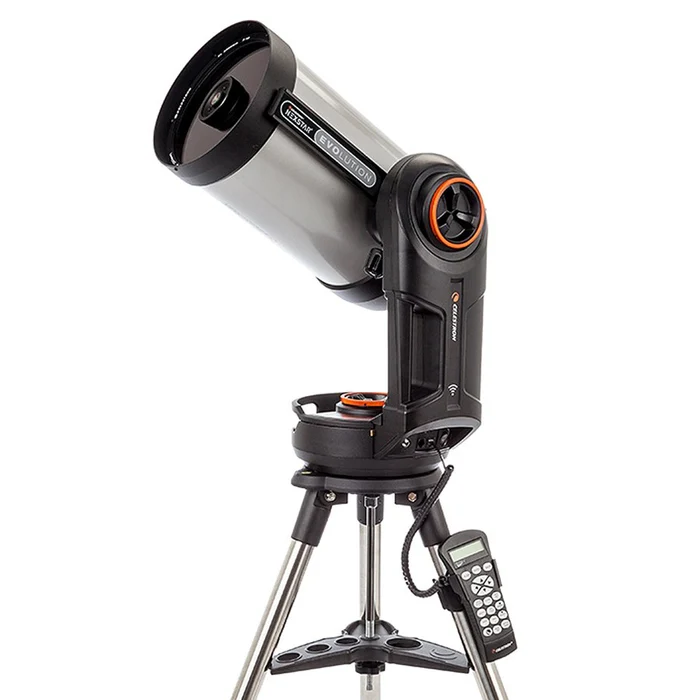
Celestron NexStar Evolution 8” Schmidt-Cassegrain Telescope
The NexStar Evolution 8” is the center of the Evolution series — the model where portability and aperture reach the most useful balance. At 203mm (8”) f/10, it’s the same C8 optical tube that has been the most popular SCT in production for decades, now integrated into Celestron’s latest mount platform: built-in LiFePO4 battery, onboard WiFi, and the NexStar+ GoTo computer. At 40.6 pounds total kit weight, it’s a one-person setup that a serious observer can carry to a dark site, set up in under 20 minutes, and trust to track accurately through a full night.
The C8 occupies a particular position in the SCT world. It has more accessories designed for it than any other telescope alive. Star diagonals, focal reducers, barlows, camera adapters, off-axis guiders, dew shields, and Hyperstar/Fastar f/2 imaging systems — the C8’s 2” rear cell thread and CG-5 dovetail interface are supported by more third-party products than any competing design. That ecosystem doesn’t exist for newer telescopes of comparable aperture, and it adds real value over the life of ownership.
The Evolution mount is well matched to the C8. The 13-pound optical tube is squarely in the design envelope for the single-arm fork — vibration settles quickly, zenith clearance is adequate with a 2” diagonal, and the tracking accuracy is sufficient for visual observing and short-exposure imaging. The 8” is not at the edge of the mount’s capability the way the 9.25” is. If you want the smoothest-handling Evolution scope that still offers serious aperture, the 8” is the answer.
What’s in the Box
-
Celestron C8 optical tube (203mm f/10 SCT, StarBright XLT coatings, CG-5 dovetail bar)
-
Single-arm fork mount with integrated LiFePO4 battery and built-in WiFi
-
2” stainless steel adjustable tripod with accessory tray
-
NexStar+ hand controller (40,000+ object database, backlit LCD, USB 2.0)
-
40mm Plössl eyepiece (51x)
-
13mm Plössl eyepiece (156x)
-
Red dot finderscope
-
1.25” star diagonal
-
Visual back
-
AC adapter (4-plug)
-
Celestron Starry Night Special Edition software
Features
-
203mm (8”) StarBright XLT Schmidt-Cassegrain Optics — StarBright XLT multi-layer coatings transmit up to 97.4% on the corrector lens. The C8 optical tube is Fastar compatible — the optional Hyperstar adapter converts it to f/2 for short-exposure wide-field imaging, a configuration with an enormous following in the amateur imaging community. At the standard f/10, the 2032mm focal length is ideal for planetary work, double stars, globular clusters, and small planetary nebulae.
-
The Most Accessory-Supported SCT in Production — The C8’s 2” rear cell thread and CG-5 dovetail have been supported by third-party manufacturers for decades. Every major accessory maker produces items explicitly designed for the C8: Starizona’s Hyperstar, Astrozap dew heaters, multiple focal reducer designs, off-axis guiders, and imaging trains. No other 8-inch telescope has this level of ecosystem support. When you buy a C8, you’re buying into 40+ years of accessory development.
-
Built-In LiFePO4 Battery — A 9-cell 6V 4.5Ah lithium iron phosphate pack is integrated into the mount head. Up to 10 hours of continuous GoTo tracking on a single charge, recharging from AC adapter, 12V vehicle outlet, or USB. No external power tank to buy, carry, or forget. Cold-weather observers should plan for 20–30% reduced capacity below freezing.
-
Integrated WiFi and SkyPortal App — The mount creates its own WiFi hotspot. Connect a smartphone or tablet and run the full session from the SkyPortal app with a 120,000-object catalog. The included NexStar+ hand controller works simultaneously and is always there as a backup. Either interface handles GoTo slewing, tracking control, and alignment.
-
NexStar+ GoTo with Brass Worm Gears — DC servo motors and brass worm gears provide nine selectable slew speeds up to 4° per second. Seven alignment procedures including SkyAlign, which finds your position from any three identifiable bright objects. The GoTo accuracy holds up over years of use; brass wears better than plastic and maintains gear mesh tolerances.
-
Alt-Az and EQ Tracking Modes — The Evolution mount operates in Alt-Az for standard visual and short-exposure imaging. Add an optional equatorial wedge and switch to EQ North or EQ South for long-exposure deep sky photography. Both modes are firmware-resident — no modification needed, just the wedge and a firmware menu change.
-
Four Auxiliary Ports and Manual Clutch — Four AUX ports on the mount accept Celestron accessories. The manual clutch lets you push the tube to a target by hand without motorized slewing. Both features are standard across the Evolution line and meaningfully speed up the workflow of a dark-site observing session.
Under the Night Sky
The 8” SCT at f/10 gives you a 2032mm focal length that delivers real planetary performance. At 51x with the 40mm eyepiece, you have slightly under 1° of true field — enough to take in most deep sky objects as complete fields. At 156x with the 13mm, Saturn’s Cassini Division resolves solidly in average suburban seeing, Jupiter shows four or five distinct cloud features including the Great Red Spot when it transits, and the lunar terminator at high magnification is an exercise in geological imagination.
For deep sky objects, 203mm opens up the NGC catalog in a meaningful way. M13 in Hercules begins to resolve stars across the core at 200x. The Virgo Cluster reveals NGC 4438, 4435, and the surrounding population of galaxies. Stephan’s Quintet shows faint at 200x but is definitively present. Small planetary nebulae like NGC 7662 (Blue Snowball) and NGC 7009 (Saturn Nebula) show structural detail. The magnitude limit of 14.0 reaches well into the fainter NGCs under dark skies.
The C8’s sweet spot is the observer who wants to do both: planets one night, deep sky the next. The 2032mm focal length is long enough for planetary work and, with a 0.63x focal reducer, becomes 1280mm f/6.3 — a genuine deep sky imaging focal length with the same optical tube. That flexibility is one of the key reasons the C8 has remained the most popular telescope of its type for over 50 years.
What Cloudy Nights Members Say
“I’ve owned a C8 in some form for 20 years. The Evolution version is the best integrated package it’s ever come in. The battery is a legitimate quality-of-life upgrade — I set up in my backyard without thinking about power, and I travel to star parties without a gel-cell. The tracking is the same C8 tracking I’ve always known.”
“For the intermediate observer ready to step up from a small scope, the Evolution 8 is the natural destination. You get real aperture, a usable GoTo system, and a tube that does what the community says it does. The C8 has a 50-year track record for a reason.”
“The mount is well matched to the C8. Vibrations settle in a second or two. I’ve used it with a 2-inch diagonal at all elevations without clearance problems. The 9.25 was always a little too big for this fork arm. The C8 is right where it should be.”
Observing Tip
Budget 40–45 minutes for cool-down when moving the C8 from a warm interior to a cold night. The 8-inch corrector plate holds thermal mass longer than you’d expect, and planetary images will noticeably improve after the tube has equilibrated. To speed this up, remove the rear cap while cooling — air circulation through the tube from back to front reduces thermal settling time. If you’re doing a pure planetary session, use a 1.25” eyepiece path rather than a 2” diagonal to minimize the length of the back-focus train. For the best results at high magnification, wait for the image of a star to settle to a steady, sharp point before calling the seeing poor — the first 10 minutes after full cool-down often reveal significantly better seeing than the initial view suggests.
Final Thoughts
The C8 is not a compromise. After 50 years of continuous production, its optics, its accessories, and its reputation are fully developed. The Evolution mount was designed around this optical tube — the balance is right, the stability is right, and the accessory ecosystem that grew up around the C8 over five decades is available to you immediately. If you’re comparing the Evolution 8” to something more expensive, the question worth asking is: how often will you actually observe? A scope that gets used beats a better scope that stays in the garage.
Frequently Asked Questions
Is the C8 better than the C9.25” for visual observing? — For most observers on most nights, yes — in the sense that the C8 is a better match for the Evolution mount. The 9.25” gathers 34% more light and resolves more detail in principle, but it sits at the upper limit of what the single-arm fork handles comfortably. The C8 is comfortably within the mount’s design range, which means better stability and faster vibration damping. The net high-power observing experience — where seeing is usually the limiting factor — often favors the well-mounted 8” over the larger 9.25”. For strictly aperture-limited work (very faint objects, maximum resolution on tight doubles), the 9.25” has a real edge.
Can I use the C8 for astrophotography without a wedge? — For planetary and lunar imaging — yes, no wedge needed. The Alt-Az tracking handles the short exposures that planetary cameras use. For long-exposure deep sky work, an equatorial wedge is required to enable the EQ tracking modes and prevent field rotation. With the wedge and a guiding setup, exposures of 1–2 minutes per frame are practical. The Hyperstar/Fastar f/2 conversion enables much shorter exposures in Alt-Az mode, which partially sidesteps the field rotation issue for wide-field targets.
How does the NexStar Evolution 8” compare to the NexStar 8SE? — Both use the C8 optical tube with StarBright XLT coatings. The Evolution 8 adds the built-in LiFePO4 battery (no external power needed), integrated WiFi (SkyPortal app control), and a manual clutch on the fork arm. The SE is a solid scope at a lower price point. The Evolution package is worth the upgrade if you value the battery convenience, app control, and improved stability.
Does the CG-5 dovetail on the C8 work with other mounts? — Yes. The CG-5 dovetail bar is a standard Celestron format compatible with CG-5, AVX, CGX, and other saddle plates that accept the CG-5 standard. The C8 optical tube can be moved to an equatorial mount later if your imaging ambitions grow beyond what the single-arm fork provides — the OTA investment is not locked to this mount.