The problem isn't your scope. It's what your scope is sitting on.
Most photo tripods come with a ball head or a fluid pan head designed for cameras — tools that want to move in one direction at a time and fight you when you need diagonal motion. Point a telescope at Jupiter sixty degrees above the horizon and swing it a degree left and a degree up at the same time, and you'll understand what we mean. You're wrestling the mount more than you're observing.
The Voyager III approaches this the right way. Separate altitude and azimuth axes, each with its own drag control. You dial in the resistance you want — free enough to swing when you're finding a target, firm enough to hold when you're looking through the eyepiece. The altitude axis has a dedicated drag knob that prevents the scope from drooping under its own weight, which is the failure mode that ends most tripod head setups for telescopes. Set it, find your target, and it stays there.
It weighs about 2.9 lbs and carries up to 11 lbs of gear. It threads onto any 3/8" tripod post — the standard used by virtually every photo tripod made in the last forty years. No special hardware, no adapters. Your tripod works.
Features
-
Separate altitude and azimuth axes with independent drag controls. Adjust resistance for each axis independently. Light for sweeping, firm for holding — exactly the control a telescope requires that a camera ball head doesn't provide.
-
Altitude drag knob prevents scope droop. The dedicated altitude drag control is the feature that sets this apart from friction-only heads. Dial it in until your scope holds position under load — no more fighting gravity every time you look away from the eyepiece.
-
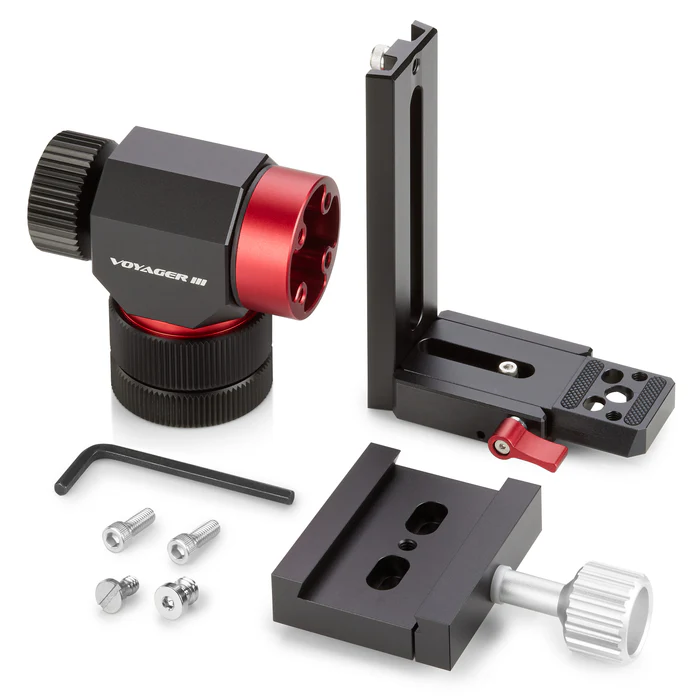
Built-in Vixen-style saddle. Accept any scope with a standard Vixen dovetail bar directly, no adapter required. Drop in your refractor or Maksutov, tighten the clamp, and you're ready.
-
Included L-bracket for cameras and non-dovetail instruments. Swap out the Vixen saddle for the L-bracket and the mount works with spotting scopes, binoculars, and cameras with standard mounting bolts.
-
3/8" tripod thread — universal compatibility. Attaches to any photo tripod with a standard 3/8" threaded post, which is virtually every tripod on the market. No proprietary hardware required.
-
11-lb payload capacity. Handles an 80mm or 90mm refractor with diagonal and eyepiece without difficulty. An AT72EDII with a 2" diagonal and 30mm eyepiece — 7+ lbs — is well within range.
-
~2.9 lbs mount weight. Light enough to pack without rethinking your kit. The mount adds less than three pounds to whatever tripod you're already carrying.
-
Machined metal construction. Precision-machined metal components throughout — not plastic pivots and nylon washers. The motion quality reflects it.
-
What's in the box. Voyager III mount head, Vixen-style clamp, L-bracket, M6 screws (×2), 3/8" screw, 1/4" screw, Allen wrench.
Under the Night Sky
The Voyager III is a visual observer's mount — the kind that rewards you for simplifying your setup. You're not tracking, not aligning, not fussing with software. You're pointing at something and looking at it.
At low to moderate magnifications — 30× to 100× — a well-adjusted alt-az head delivers everything you need for the Moon, planets, and bright deep-sky objects. The Moon at 60× on an 80mm refractor is one of the best casual astronomy experiences there is. The Voyager III holds steady while you work your way along the terminator, crater to crater. No vibration from motorized tracking, no polar alignment to worry about. Just the view.
For planetary work at higher power — Jupiter's cloud bands at 120×, Saturn's rings and Cassini Division at 150× — the altitude drag adjustment earns its place. You nudge the scope forward as the planet drifts across the field, and the head stays exactly where you put it between nudges. No creep. On a night with steady seeing, you'll forget you're on a manual mount.
The Voyager III earns its keep beyond the telescope too. A 65mm spotting scope on the L-bracket makes it a compelling daytime mount for birding and nature watching. The same fluid azimuth and altitude motion that helps you track a planet helps you follow a bird through the trees. And unlike a fluid video head, the axes move independently — you're not fighting gimbal resistance when you want pure azimuth motion.
Observing Tip
The altitude drag knob rewards a little experimentation. Start with it looser than you think you need, then tighten it one small increment at a time until the scope holds position without assistance. A well-set altitude drag means you can nudge the scope upward with a light touch and it stays — but doesn't require force to move. Finding that setting for your particular scope and eyepiece combination takes a few minutes. Once you find it, note where the knob sits and you'll be back there in seconds on your next session.
Community Says
Cloudy Nights observers have been putting the Voyager III through its paces:
"I think it's very well done… smooth and solid, with clutches that work better than any TelePod I've used. I had my scope on it in 20–30 mph winds, and it handled it like a champ."
"The altitude drag knob is a game changer. No more scope droop or creeping downward — I can fine-tune the motion and still nudge easily. It just stays where I put it."
"Works great with my 80mm and 90mm scopes. It's stable, smooth, and doesn't bounce around like some of the lighter heads I've used."
"Setup took me less than five minutes. It threads right onto a standard photo tripod and just works. A perfect mount for casual nights under the stars."
"Love the built-in Vixen saddle. I swapped out the included L-bracket and dropped in my ED refractor — no adapters, no hassle."
Frequently Asked Questions
Why not just use a ball head from my camera bag?
Ball heads are designed to lock a camera at a fixed angle and hold it there — they're not built for the continuous, fine motion control a telescope requires. When you loosen a ball head enough to move smoothly, it tends to swing past where you wanted it and sag under load. The Voyager III uses separate altitude and azimuth axes with independent drag controls, so you can dial in exactly the resistance you need for each direction of motion. It's a different tool for a different job.
What size scopes does it work with?
The Voyager III handles scopes up to about 11 lbs comfortably. That covers most 60–90mm refractors, small Maksutov-Cassegrains, and spotting scopes. An AT72EDII with diagonal and eyepiece at 7+ lbs works well per verified buyer experience. The built-in Vixen saddle accepts any scope with a standard Vixen dovetail bar — which includes most small AT refractors and many other manufacturers' designs.
Does a tripod come with it?
No — the Voyager III is the mount head only. It attaches to any photo tripod with a standard 3/8" threaded post, which is the universal standard for full-size photo tripods. If you already own a decent photo tripod, it will work. A sturdy tripod is worth pairing with this head — a lightweight travel tripod rated for 5 lbs will limit the mount's potential regardless of how good the head is.
How does the Vixen saddle swap to the L-bracket?
The Vixen-style clamp and the L-bracket are both removable. The L-bracket accepts cameras, spotting scopes, and binoculars via standard 1/4" or 3/8" mounting screws (both included). Switching between them takes about a minute with the included Allen wrench.
Can I use this for astrophotography?
For untracked wide-field or short-exposure work — solar imaging, Moon photography, daytime spotting — yes. For long-exposure deep-sky imaging, no: without a tracking motor and polar alignment, exposures beyond 2–3 seconds will trail. The Voyager III is a visual observing mount that handles short-exposure photography well but isn't designed as a dedicated imaging platform.
Final Thoughts
Most alt-az heads at this price are friction heads — they hold position by clamping down, and moving them means fighting that clamp. The Voyager III gives you proper drag-controlled motion on both axes and a dedicated altitude knob that keeps your scope from fighting gravity. That's a meaningful difference the first time you spend a night on the Moon or a planet at moderate power. The setup takes seconds, the weight barely registers in your bag, and the mount gets out of the way and lets you observe. For a grab-and-go visual setup, that's exactly what you want.