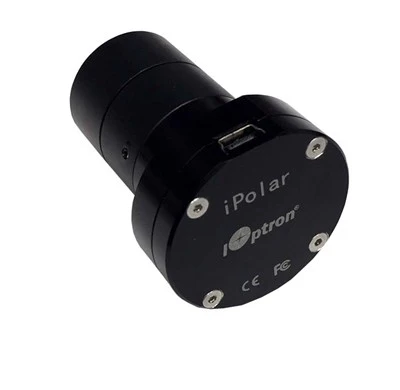
Polar alignment is one of those jobs that has to be done well, but there is no reason it has to be difficult. The iOptron iPolar is an electronic polar scope that uses a built-in camera and plate-solving software to show you exactly how to adjust your mount toward the celestial pole.
You do not have to identify Polaris, Sigma Octantis, or memorize a reticle position. Point the mount roughly toward the appropriate celestial pole, connect iPolar to a Windows computer, and let the software identify the star field. On-screen instructions then guide you through the altitude and azimuth adjustments needed to complete the alignment.
iOptron specifies a maximum alignment precision of approximately 30 arcseconds, making iPolar useful for both visual setups and astrophotography where accurate polar alignment can reduce field rotation and make guiding easier.
Features
-
Up to 30-arcsecond alignment precision. iOptron specifies maximum polar-alignment accuracy of approximately 30 arcseconds.
-
No need to identify the Pole Star. Polaris does not have to be visible in the Northern Hemisphere, and Sigma Octantis does not have to be visible in the Southern Hemisphere.
-
Smart plate solving. iPolar analyzes the star field around the celestial pole and determines the mount's alignment electronically.
-
On-screen alignment instructions. The software shows you how to adjust the mount's altitude and azimuth controls until the polar position and mount axis coincide.
-
Approximately 13° field of view. The relatively wide camera field makes initial positioning more forgiving than trying to center a star through a conventional polar-scope reticle.
-
USB plug-and-play operation. The camera connects by USB and does not require a separate camera driver.
-
Works in either hemisphere. The same iPolar system can be used for northern or southern polar alignment.
-
Designed for difficult sky conditions. Image processing and adjustable exposure settings help iPolar detect the polar-region star field when visibility is less than ideal.
-
Compatible with many equatorial mounts. Different internal and external adapters allow iPolar to be used with a broad range of iOptron and non-iOptron mounts.
-
Windows 11 support. Current iPolar software supports 64-bit Windows 7, 8.1, 10, and 11 with Microsoft .NET Framework 4.8 or later.
You Don't Have to See Polaris
A conventional polar scope normally asks you to identify a particular reference star and place it at a particular location on a reticle. iPolar approaches the problem differently.
The camera looks at a roughly 13° field surrounding the celestial pole. The software detects the stars in that field, plate solves the image, and calculates where the true celestial pole lies relative to the mount's right-ascension axis.
That means Polaris itself does not have to be visible. The same is true of Sigma Octantis in the Southern Hemisphere. What iPolar does need is enough usable sky around the pole for the software to identify the surrounding star field.
That distinction can be important from a backyard. A tree branch or part of a building in the field does not automatically make polar alignment impossible. The iPolar software even includes a masking function that lets you tell the plate solver to ignore obstructed portions of the image.
Plate Solving Instead of a Reticle
Once the camera is connected and the mount is pointed roughly toward the pole, iPolar begins analyzing the star field.
The software determines the relationship between the camera, the mount's RA axis, and the true celestial pole. It then displays the mount-axis position and virtual pole on screen.
Use the mount's altitude and azimuth adjustments to bring the two together. As you get closer, the software zooms the display to make the final adjustment easier. When the indicators overlap, the polar alignment is complete.
There is no need to estimate where Polaris belongs on a clock face or read a dim reticle in the dark. You make the mechanical adjustments while iPolar shows you the result on screen.
30-Arcsecond Alignment Precision
iOptron specifies both camera resolution and maximum alignment precision at approximately 30 arcseconds.
That is far more precision than is normally required simply to put a GoTo mount on the correct part of the sky. For astrophotography, however, better polar alignment reduces the amount of declination correction a guider has to make and helps minimize field rotation during long imaging sessions.
Polar alignment is only one part of accurate tracking — periodic error, guiding, seeing, flexure, and the rest of the imaging system still matter — but starting with the RA axis accurately aligned removes one unnecessary source of error.
Compatible with More Than iOptron Mounts
iPolar can be installed internally on many iOptron equatorial mounts or attached externally with the appropriate adapter.
iOptron offers mounting solutions for a wide range of its own HAE, HEM, CEM, GEM, iEQ, SkyGuider, and tracker models, along with adapters for selected mounts from Celestron, Sky-Watcher, Takahashi, Losmandy, and others.
Because the mounting method varies from one telescope mount to another, make sure you select the correct iPolar version or adapter for your particular mount when ordering.
A Useful Tool for Partially Obstructed Backyards
One of iPolar's more useful software features is easy to overlook.
If tree branches or part of a building intrude into the camera's field, the software allows portions of the image to be masked so they are ignored during plate solving. As long as enough of the polar-region star field remains visible for a successful solve, a partially obstructed view does not necessarily prevent alignment.
That does not mean iPolar can align through a completely blocked sky. The camera still has to see enough stars around the celestial pole to determine where it is pointing. What it removes is the requirement that the traditional Pole Star itself be visible.
Frequently Asked Questions
Do I need to see Polaris?
No. iPolar plate solves the surrounding polar-region star field, so Polaris itself does not need to be visible. In the Southern Hemisphere, Sigma Octantis likewise does not have to be visible.
Can I use iPolar if a tree or building blocks part of the sky?
Potentially. The software includes a mask function that can exclude obstructed portions of the image from plate solving. Enough stars around the celestial pole still need to remain visible for the software to solve the field.
How accurately can it polar align?
iOptron specifies maximum alignment precision of approximately 30 arcseconds.
What is the field of view?
Approximately 13 degrees. During setup, the mount should be pointed roughly toward the celestial pole so that the polar region falls within the camera's field.
Does iPolar work in both hemispheres?
Yes. The software works in both the Northern and Southern Hemispheres.
Does it require a special camera driver?
No. iOptron describes iPolar as USB plug-and-play, without a separate camera driver.
What computer does it require?
The current iOptron iPolar software supports 64-bit Windows 7, 8.1, 10, and 11 with Microsoft .NET Framework 4.8 or later.
Will it fit my mount?
iPolar works with a wide range of equatorial mounts, but the required mounting hardware varies. Some mounts accept an internal iPolar while others require a model-specific external adapter.
Do I have to rotate the mount during setup?
Depending on the installation and whether the camera center has already been established, the software may instruct you to rotate the RA axis while it determines the relationship between the camera and mount axis. Follow the current iPolar software instructions for your installation.
Final Thoughts
A good electronic polar scope should make polar alignment less of a ritual and more of a setup step. That is what iPolar does well.
Its camera and plate-solving software replace the traditional reticle with an on-screen view of where the mount is actually pointed and where it needs to go. You do not have to identify Polaris, the same system works in either hemisphere, and approximately 30-arcsecond alignment precision provides plenty of accuracy for a serious imaging setup.
If polar alignment is the part of setting up an equatorial mount that you would rather spend less time thinking about, iPolar turns it into a straightforward process: connect the camera, let the software solve the sky, adjust the mount, and move on to observing or imaging.