This Product Has Been Discontinued. This Page Is Here For Informational Purposes Only.
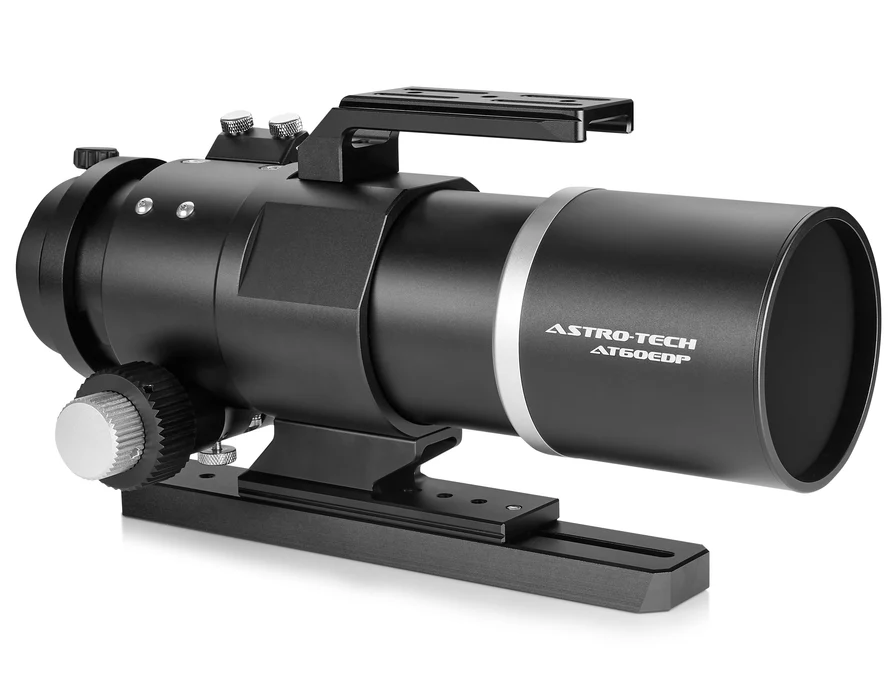
Most small refractors ask you to buy a separate field flattener or reducer to get round stars across your imaging chip. Then you spend an evening shimming spacers and measuring back focus before you ever take a single frame. The AT60EDP skips all of that. It's a four-element Petzval astrograph with the field correction built into the optical design — two ED elements (FCD-100 and FK-61) arranged in a Petzval configuration that delivers a flat, corrected 44mm image circle straight out of the focuser. Attach your camera and shoot.
Imaging Only
This is not a visual telescope. The Petzval design places its rear element group close to the focal plane, leaving no room for an eyepiece to reach focus. The AT60EDP is built to do one thing — put round, color-free stars on your sensor across a wide field — and it does that with the kind of precision that usually costs considerably more.
The Optics
Four elements in two groups. The front group uses FCD-100 extra-low dispersion glass; the rear group uses FK-61 (FPL-51 equivalent). Together they produce tight, well-corrected star images with virtually no chromatic aberration — owners consistently report clean color even on bright stars. The 300mm focal length at f/5 gives you wide-field coverage that frames large nebula complexes, the full extent of the Andromeda Galaxy, and sweeping Milky Way star fields. On an APS-C sensor, the field of view runs roughly 2.9° × 1.9°.
Built Like a Tank
Owners who pick up the AT60EDP for the first time tend to comment on the same thing: it's heavier than it looks. At 6.9 pounds, it has a density and solidity that you don't expect from a 60mm scope. The focuser is a 2.8-inch dual-speed rack-and-pinion with 10:1 fine focus, 1mm scale markings on the drawtube, a lock knob, and a 48mm T-thread output. A built-in 360° rotating camera angle adjuster lets you frame your target without loosening the tube rings. The sliding dew shield extends for use and retracts for transport. A Vixen-style dovetail mounting shoe on the bottom and a handle on top mean you can ride it piggyback on a larger scope or mount it directly on a small tracking mount.
What's Included
- Astro-Tech AT60EDP 60mm f/5 Dual ED Petzval OTA
- Tube rings (pair)
- Vixen-style dovetail bar
- 360° rotating camera angle adjuster
- Finder scope mounting shoe
- Front and rear dust covers
- Padded carry bag
Features
-
Four-element Petzval optical design — Two ED glass groups (FCD-100 + FK-61) with built-in field flattener. No separate flattener or reducer to buy, space, or align.
-
44mm flat image circle — Covers APS-C sensors fully with round stars to the corners. Owners report no vignetting on the ASI2600MC and similar APS-C chips.
-
300mm f/5 focal length — Wide-field framing for large nebula complexes, galaxy groups, and Milky Way panoramas. Fast enough for reasonable exposure times on faint targets.
-
Virtually zero chromatic aberration — The dual-ED design produces clean color on bright stars without the purple halos that plague simpler doublets.
-
2.8" dual-speed rack-and-pinion focuser — 10:1 fine focus ratio, 1mm drawtube scale markings, lock knob, and 48mm T-thread output. Compatible with ZWO and other electronic autofocusers.
-
Built-in 360° camera angle adjuster — Rotate your camera to frame targets without loosening the tube rings or disturbing your polar alignment.
-
55mm back focus — Standard DSLR spacing. Dedicated astronomy cameras may need a short spacer to reach the correct distance.
-
Piggyback-ready mounting shoe — Vixen dovetail on the bottom, carry handle on top. Mount it on a small tracker or ride it on a larger scope as a widefield companion.
-
Sliding dew shield — Extends for observing, retracts to shorten the tube for transport and storage.
-
Padded carry bag included — Compact enough for airline carry-on or a gear bag. Reviewers praise it as a capable travel astrograph.
Imaging Targets
At 300mm and f/5, the AT60EDP frames wide. On an APS-C sensor, you'll capture the full sweep of the Orion Molecular Cloud with room to spare, the entire Andromeda Galaxy (M31) with its companion galaxies, the Heart and Soul Nebulae side by side, and the North America and Pelican Nebulae in a single frame. For narrowband work, the Veil Nebula complex fits beautifully, and the Cygnus region becomes a mosaic of hydrogen-alpha structure you can capture in single panels rather than multi-frame mosaics. Owners using mono cameras with dual-narrowband and quad-band filters report excellent results — the clean color correction means your filter work shows up without competing against optical artifacts.
Community Says
"My chief regret after buying and using an AT60EDP, is not the Petzval design, or the quality of the ED glass, or the wide and flat field of view, or the excellent build quality. It is the price."
— Cloudy Nights AT60EDP discussion. This owner paid full price before the closeout — and was joking that lowering the price was the only thing to complain about.
Imaging Tip
The AT60EDP's 55mm back focus is designed for standard DSLR spacing (T-ring + camera body). If you're using a dedicated astronomy camera with a filter drawer, measure your imaging train carefully — several owners report needing an 8mm M48 spacer to reach focus with a filter drawer in the optical path. Mark your focuser position with the drawtube scale once you've dialed it in, and you'll hit focus on the first try every session.
FAQ
Can I use this visually with an eyepiece?
No. The Petzval design places its rear optical group too close to the focal plane for an eyepiece to reach focus. This is a dedicated astrograph — imaging only.
Do I need a separate field flattener or focal reducer?
No. The four-element Petzval design has field correction built in. The 44mm image circle is flat from center to edge. This is one of the AT60EDP's key advantages — no extra optics to buy, space, or align.
What cameras work with this scope?
DSLR and mirrorless cameras connect via a T-ring for your specific mount (sold separately). Dedicated CMOS and CCD astronomy cameras typically have 48mm T-threads built in and connect directly without a T-ring. Owners report excellent results with ASI2600MC, ASI2600MM-Pro, ASI533MC Pro, ASI294, Canon 60Da, and Player One Poseidon cameras.
Will it cover a full-frame sensor?
The 44mm image circle fully illuminates APS-C sensors. Full-frame sensors (43.3mm diagonal) are right at the edge of the specified image circle. Some owners believe it will cover full frame, but most confirmed results are on APS-C chips. If full-frame edge-to-edge correction is critical, test before committing to long integration times.
What mount does it need?
At 6.9 pounds (plus camera), the AT60EDP works well on small tracking mounts — owners report success with the Star Adventurer, Star Explorer 2i, and iOptron SkyGuider Pro. It also piggybacks nicely on a larger scope using the Vixen dovetail mounting shoe.
Why is the focuser travel limited with some setups?
The 55mm back focus assumes a direct camera connection (T-ring + body, or dedicated camera with T-thread). Adding a filter drawer to the imaging train shortens the available spacing. An 8mm M48 spacer, placed between the focuser and the filter drawer, solves this for most configurations.
Final Thoughts
The AT60EDP was built for imagers who wanted a grab-and-go widefield astrograph without the fuss of spacing a separate flattener or reducer. It delivered on that promise — 17 five-star reviews, round stars to the corners, and owners who stopped shopping for alternatives after using it. It's discontinued now, and the closeout price makes it an even better value than it was at full retail. If you image wide fields and want a scope that's ready to shoot the moment you attach a camera, this is one of the most straightforward imaging setups we've ever carried.