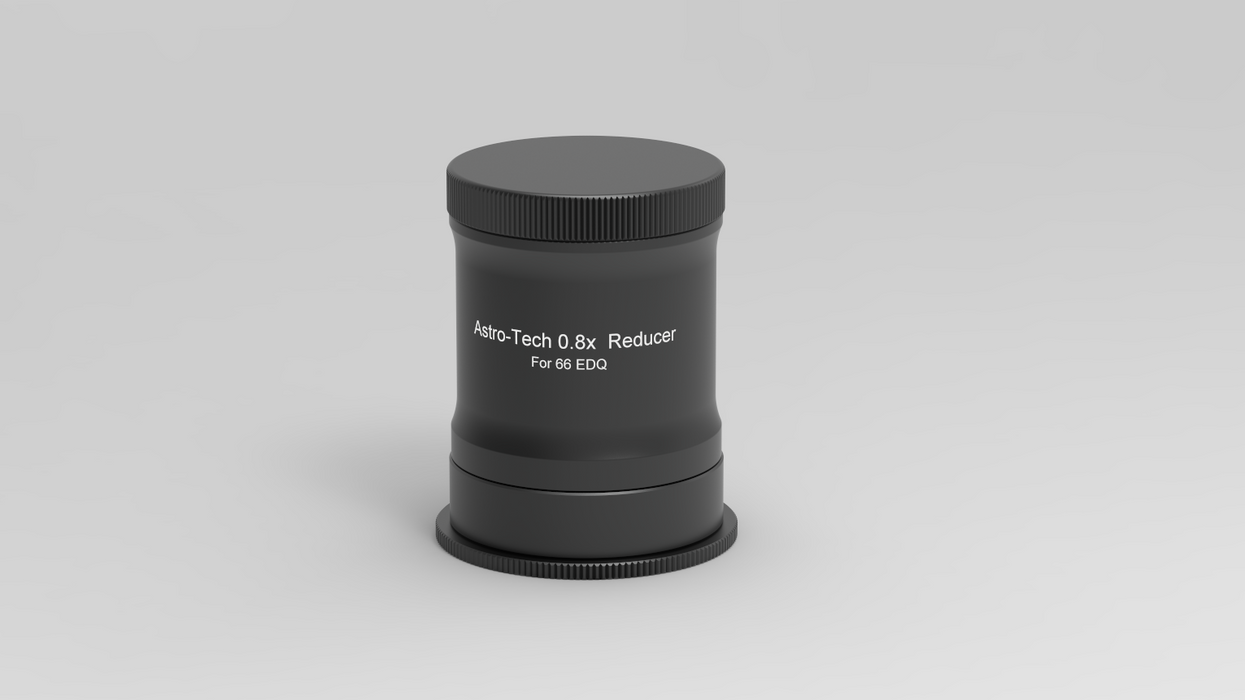
Astro-Tech AT66EDQR 0.8× Reducer for the AT66EDQ
The AT66EDQ’s most useful quality for imaging isn’t something that shows up prominently in the specs: it produces a genuinely flat field across a full-frame sensor without a separate field flattener. Most refractors — even good ones — need that extra element. The AT66EDQ doesn’t. The AT66EDQR reducer preserves that optical behavior while doing two things that matter for wide-field imaging: it shortens the focal length from 462mm to 370mm and brightens the system from f/7 to f/5.6.
At 370mm f/5.6, the AT66EDQ becomes a serious wide-field imaging platform. The Orion Nebula complex fits comfortably in a single frame. The Pleiades with surrounding nebulosity. The large emission nebulae in Cygnus — the Veil, the North America, the Pelican — which become cramped at longer focal lengths. And at f/5.6, an exposure that would take 8 minutes at f/7 finishes in about 5. On a night with limited time or variable transparency, that’s a meaningful difference.
The camera side of the reducer uses standard 48mm T-threads, connecting to a T-ring for DSLR and mirrorless bodies, or directly to dedicated CMOS and CCD astronomy cameras, which come with 48mm T-threads built in. Back focus from the reducer shoulder to the image plane is 55mm — the industry-standard spacing, so there’s no guesswork in your camera positioning. A soft rubber cap covers the T-threads when not in use; a second cap protects the scope-side barrel.
This reducer is designed for the AT66EDQ specifically. It works with the quadruplet’s optical geometry to maintain flat-field performance across the full sensor. It is not interchangeable with other AT refractors.
What’s in the Box
- Astro-Tech AT66EDQR 0.8× focal reducer
- Camera-side rubber dust cap
- Scope-side rubber dust cap
Features
-
0.8× reduction — focal length 462mm → 370mm; f/ratio f/7 → f/5.6; approximately 36% shorter exposures for equivalent signal
-
Flat-field performance preserved — designed specifically for the AT66EDQ quadruplet; sharp stars to the corners of full-frame sensors
-
Fully multi-coated optics — maximum light transmission; no additional flare or scatter introduced into the optical path
-
48mm T-thread camera connection — DSLR and mirrorless bodies connect via a T-ring (sold separately); dedicated CMOS/CCD astronomy cameras attach directly — 48mm T-threads are standard on most
-
55mm back focus — industry-standard spacing from reducer shoulder to image plane; no guesswork required
-
AT66EDQ-specific design — matched to the quadruplet’s geometry; not compatible with other AT refractors
Frequently Asked Questions
What camera bodies work with this reducer? — DSLR and mirrorless cameras connect via a T-ring for your specific mount (sold separately) — available for Canon EF, Nikon F, Sony E, Fuji X, and most others. Dedicated CMOS and CCD astronomy cameras typically have 48mm T-threads built in and connect directly without a T-ring.
Do I need anything else to connect my camera? — You need a T-ring for your camera mount (sold separately). The T-ring threads onto the reducer's 48mm T-thread and attaches to your camera body. No other adapters are required.
Do dedicated astronomy cameras need a T-ring? — Yes, with the appropriate T-ring for your mirrorless mount (sold separately). Dedicated CMOS and CCD astronomy cameras attach directly — no T-ring needed. In all cases, back focus from the reducer to the image plane is 55mm — confirm this works with your camera’s flange-to-sensor distance.
Can I use this reducer with other AT refractors? — No. The AT66EDQR is designed specifically for the optical geometry of the AT66EDQ quadruplet. Using it with other scopes will not maintain flat-field performance and may produce poor corner stars.