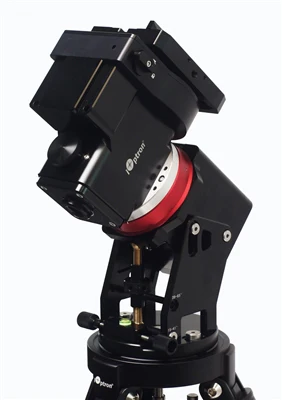
The iOptron HEM27EC takes the exceptionally light HEM27 platform and adds a high-precision encoder to the right-ascension axis. For an imager, that encoder is the reason to choose the EC version.
The mount head weighs just 8.15 lb (3.7 kg) with the saddle installed, yet iOptron rates it to carry 29.7 lb (13.5 kg) without a counterweight. The RA axis uses a strain-wave drive for high torque in a compact package, while declination uses iOptron's backlash-free worm-and-belt system. The EC version then adds a high-precision RA encoder with Real-Time Periodic Error Correction to continuously reduce tracking error while the mount follows the sky.
That can make unguided imaging practical with appropriately forgiving systems, but the encoder has another advantage that may matter even more at demanding image scales: it allows the guider to concentrate on slower tracking errors instead of constantly chasing the strain-wave drive itself.
This H274 version does not include iPolar, making it a natural fit for imagers who already polar align through NINA, SharpCap, ASIAIR, PHD2, or another software-based routine.
Features
-
High-precision RA encoder with Real-Time PEC. The encoder continuously monitors right-ascension motion and allows the mount to correct much of the strain-wave drive's tracking error internally.
-
29.7 lb counterweight-free payload. Carry up to 13.5 kg without a conventional counterweight shaft and stack of weights.
-
Only 8.15 lb with the saddle installed. A payload-to-mount-weight ratio of approximately 3.65:1.
-
Up to 44 lb with a counterweight. Add the optional shaft and counterweight when a heavier or more demanding telescope configuration calls for additional capacity.
-
Hybrid drive system. Right ascension uses a 480:1 strain-wave drive while declination uses iOptron's backlash-free worm-and-belt system.
-
360-second RA gear period. The high-precision encoder and Real-Time PEC work directly with the tracking behavior of the strain-wave RA drive.
-
RA guiding filter. The mount can either accept external RA guide corrections or filter them and allow the encoder to handle RA tracking while the guider continues correcting declination.
-
Go2Nova 8409 hand controller included. Standalone GoTo operation with an approximately 212,000-object database and nine slew speeds up to 6° per second.
-
Wi-Fi through the hand controller. The 8409 provides wireless connectivity for compatible applications such as iOptron Commander Lite and SkySafari.
-
Integrated ST-4 autoguider port. Traditional guiding remains available in addition to software-based pulse guiding.
-
Power and USB pass-through at the saddle. Two 12V outputs with a combined 4A maximum and USB 2.0 pass-through help keep camera and accessory cabling close to the telescope.
-
Electronic friction brake. Designed to stop the mount safely during a planned or unexpected interruption in power.
-
Automatic zero-position search. Built-in sensing allows the mount to locate its reference position electronically.
-
Vixen/Losmandy-D convertible saddle. Accepts either dovetail standard, although switching between them requires reconfiguring the saddle hardware.
-
Soft carrying case included. Appropriate for a mount whose biggest advantage is how easily it travels.
What the Encoder Changes
Strain-wave gearing is what makes the HEM27 possible. It produces enough torque for an eight-pound mount head to carry several times its own weight without requiring a conventional counterweight system.
The tradeoff is that strain-wave tracking error behaves differently from the relatively smooth periodic error of a traditional worm gear. On a standard non-encoder strain-wave mount, the guider often has to make relatively frequent RA corrections to keep up with those changes.
The HEM27EC adds another layer of information. Its high-precision encoder continuously measures the RA axis and allows the control system to correct tracking error in real time.
iOptron says the resulting tracking accuracy is good enough that many users may choose to image without guiding, particularly with shorter focal lengths and more forgiving image scales.
That does not mean every HEM27EC becomes an unguided mount under every telescope. Polar alignment, focal length, camera pixel size, exposure length, payload geometry, seeing, and the level of star quality you expect all still matter.
The better way to think about the encoder is that the RA axis is already correcting itself before an external guider enters the picture.
A Different Approach to Guiding
The HEM27EC can also be guided differently from the standard HEM27.
On a non-encoder strain-wave mount, very short guide exposures are often recommended so the guider can react quickly enough to the RA tracking error. That can be inconvenient with an off-axis guider, where faint guide stars may need longer exposures.
iOptron specifically recommends a different approach with its high-precision encoder models. Because the encoder handles the faster RA error internally, external guide corrections can be spaced farther apart and used primarily to correct slower effects such as polar-alignment error, atmospheric refraction, and flexure.
iOptron suggests guide cadences in the neighborhood of 5 to 10 seconds as a useful starting point for encoder-equipped mounts. That is not a universal setting, but it explains one of the practical benefits of the EC design: you can give an off-axis guider more time to collect enough signal from a faint guide star without leaving the strain-wave drive completely unattended between corrections.
The 8409 hand controller also gives you two RA guiding choices. “Allow RA Guiding” lets the mount receive external RA corrections while the encoder continues working between guide pulses. “Filter R.A. Guiding” ignores external RA corrections and leaves the encoder responsible for RA while the guider handles declination.
Which approach works best depends on the telescope and imaging system. Judge it from the stars in the actual exposures rather than from the smallest RMS number you can produce on a graph.
Unguided Imaging
The encoder also makes unguided imaging a realistic experiment rather than just a theoretical possibility.
At short-to-moderate focal lengths, some HEM27EC owners have produced multi-minute exposures with round stars using only the encoder for RA tracking. That makes a very compact travel system possible: mount, telescope, camera, and polar-alignment method without a separate guide scope and guide camera.
But unguided results vary. A system that works beautifully at 400 or 500mm may behave very differently at 1,000mm, and declination drift from polar-alignment error is unaffected by the RA encoder.
For long focal lengths, fine image scales, or sessions where consistently high keeper rates matter more than minimizing hardware, guiding remains the safer approach.
The EC advantage does not disappear when you guide. The guider is simply starting with much less raw RA tracking error to correct.
29.7 Pounds Without a Counterweight
The encoder gets the attention on the EC model, but underneath it is still one of the lightest mounts capable of carrying a serious imaging rig.
iOptron rates the HEM27EC for 29.7 lb (13.5 kg) without a counterweight. The mount head weighs only 8.15 lb with the saddle installed.
There is an important qualification to that payload number. iOptron bases the rating on the payload's center of gravity being approximately 200mm from the RA axis, or an optical tube roughly 220mm in diameter.
A compact 25-pound astrograph and a long 25-pound refractor therefore do not present the same load to the mount. Longer tubes, large rear-mounted imaging trains, and wind-sensitive systems deserve additional margin below the published rating.
The optional counterweight shaft and weight raise the published capacity to 44 lb and can also be useful with certain larger or more demanding payloads even when they remain below the basic counterweight-free limit.
This Version Does Not Include iPolar
The H274 is the HEM27EC without iPolar. It does not include a conventional optical polar scope either.
That makes sense for imagers who already polar align through the imaging system. NINA, SharpCap, ASIAIR, PHD2, and other software-based routines can provide accurate polar alignment without adding another dedicated camera to the mount.
Good polar alignment becomes particularly important if you plan to experiment with unguided imaging. The encoder corrects right ascension; it cannot remove declination drift caused by a poorly aligned polar axis.
If you prefer iOptron's dedicated electronic polar-alignment system, an iPolar-equipped HEM27EC configuration is also available.
Why iOptron Calls It a Hybrid
The HEM27EC is not a conventional German equatorial mount and it is not a dual-strain-wave mount either.
Right ascension uses strain-wave gearing because that is where high torque and counterweight-free operation provide the largest practical advantage.
Declination uses iOptron's worm-and-belt system, which the company describes as backlash-free. The DEC axis includes a gear switch so it can be released for balancing.
No conventional RA balancing is required. That is one of the reasons the HEM27EC can go from case to telescope so quickly in the field.
From the Cloudy Nights Community
HEM27EC owners on Cloudy Nights show why the encoder is best presented as a useful tool rather than a promise that guiding disappears.
One owner tested consecutive five-minute unguided exposures at 560mm focal length and reported round stars after dialing in the system. With a heavier refractor, that same owner found that adding a counterweight improved the unguided result depending on which side of the meridian the telescope was operating.
Another owner approached the HEM27EC hoping the encoder would eliminate guiding at medium focal lengths and ultimately found that he still preferred to guide. His experience was that the EC version allowed longer guide intervals, which made it more practical to use longer-focal-length telescopes and off-axis guiders.
That second result lines up closely with iOptron's own guidance. The company specifically recommends longer-cadence guiding on the EC model so the encoder handles the faster RA corrections while the guider addresses slower errors.
Other HEM27EC users have reported good results with guide exposures around several seconds, but the community does not converge on one magic number. Telescope, guider, seeing, polar alignment, payload, and software settings all influence the final result.
The useful takeaway is straightforward: the encoder substantially changes the RA tracking behavior, but the final imaging performance still belongs to the complete system.
A Few Setup Details Worth Knowing
The HEM27EC shares the same mechanical details as the standard HEM27.
The altitude and azimuth locks use socket-head hardware rather than large hand knobs, so keeping the appropriate hex tool in the case makes field setup easier.
The latitude mechanism normally covers two ranges, 15–41° and 39–65°. Moving between them requires relocating hardware, so check the mount configuration before traveling a significant distance north or south.
The saddle is also convertible rather than instantly dual-width. It ships configured for Vixen plates, and converting to Losmandy-D requires repositioning and flipping parts of the saddle assembly.
None of these are major issues, but they are worth knowing before the first night under the stars rather than discovering them with a flashlight in your teeth.
What's Included
- iOptron HEM27EC hybrid strain-wave equatorial mount head
- High-precision RA encoder with Real-Time PEC
- Vixen/Losmandy-D convertible dovetail saddle
- Go2Nova 8409 hand controller
- 6P6C coiled hand-controller cable
- 12V/5A AC adapter for indoor use
- USB cable for mount control
- Soft carrying case
Not included: tripod, counterweight shaft and counterweight, or iPolar electronic polar scope.
Frequently Asked Questions
What does the EC add to the standard HEM27?
The HEM27EC adds a high-precision encoder to the right-ascension axis along with iOptron's Real-Time Periodic Error Correction. The basic hybrid drive, payload capacity, hand controller, cabling, and other mechanical features remain essentially the same.
Does the encoder eliminate periodic error?
It substantially reduces the effect of the RA strain-wave drive's tracking error by measuring the axis and applying corrections in real time. It should not be treated as a guarantee of perfect tracking under every telescope or image scale.
Can I image without guiding?
Potentially. iOptron says the encoder provides enough tracking accuracy that many owners may choose to image without guiding, particularly at shorter focal lengths. Owner reports include successful multi-minute unguided imaging, but results vary with focal length, pixel scale, polar alignment, payload, and the individual imaging system.
Should I guide the HEM27EC differently from the standard HEM27?
Usually. A standard strain-wave mount often benefits from rapid guide corrections. On the HEM27EC, the encoder is already handling much of the faster RA tracking error. iOptron therefore recommends experimenting with longer guide cadences — often around 5 to 10 seconds — so the guider concentrates on slower errors.
What does “Filter R.A. Guiding” do?
It tells the mount to ignore external RA guide commands and let the high-precision encoder handle RA tracking while the guider continues correcting declination. “Allow RA Guiding” accepts external RA corrections while the encoder continues operating between guide pulses.
Does the HEM27EC include iPolar?
This H274 version does not. The HEM27EC is also offered in an iPolar-equipped configuration for customers who want iOptron's dedicated electronic polar-alignment system.
How important is polar alignment if I want to image unguided?
Very important. The RA encoder corrects the right-ascension drive, but it cannot correct declination drift caused by polar-alignment error. The more demanding the unguided exposure, the more important accurate polar alignment becomes.
How much can the HEM27EC carry without a counterweight?
iOptron rates it for 29.7 lb (13.5 kg) without a counterweight. The rating assumes the payload center of gravity is approximately 200mm from the RA axis, so telescope geometry matters along with total weight.
How much can it carry with a counterweight?
With the optional counterweight system, iOptron publishes a maximum payload of 44 lb (20 kg), subject to the same payload-geometry considerations.
Does it support autoguiding?
Yes. The mount includes an ST-4-compatible autoguider port and also supports software-based pulse guiding. The EC model additionally lets you choose whether external RA guide commands are accepted or filtered.
What tripod fits it?
The HEM27EC can mount directly to compatible iOptron CEM26/GEM28/HEM27/HAE29 tripod systems, including the matched LiteRoc and compatible carbon-fiber tripod. A MiniPier can provide additional clearance for longer refractors or deep rear-mounted imaging trains.
Final Thoughts
The HEM27EC is for the imager who wants the portability of the standard HEM27 but wants the RA axis doing more of its own correction.
You still get the feature that makes the HEM27 remarkable: 29.7 pounds of counterweight-free capacity in a mount head weighing just 8.15 pounds.
The EC version adds a high-precision RA encoder and Real-Time PEC. At forgiving image scales, that can make multi-minute unguided imaging practical. When you do guide, it allows a different strategy: let the encoder handle the faster RA behavior while the guider concentrates on the slower errors that remain.
This H274 configuration leaves out iPolar, which makes sense if your imaging workflow already includes software-based polar alignment.
If you want a genuinely portable imaging mount but also want more sophisticated RA tracking than the standard HEM27 provides, that is the reason to choose the HEM27EC.
Tech Details:
| Mount Type |
Hybrid Equatorial Mount (HEM) |
| RA Gear System |
StrainWave 17 |
| DEC Gear System |
Backlash-free worm/belt system |
| RA Reduction Ratio |
120 |
| High-Precision Encoder |
Yes (RA axis) |
| PEC |
Real-time PEC (via RA encoder) |
| Payload without Counterweight |
29.7 lb (13.5 kg)* |
| Payload with Counterweight |
44 lb (20 kg) |
| Mount Weight |
8.15 lb (3.7 kg) with dovetail saddle; 7.49 lb (3.4 kg) without |
| Payload / Mount Weight |
3.65 |
| Structure |
All metal, cast + CNC machined, black anodized |
| Gear Period |
360 seconds |
| Drive Motor |
Stepper motor |
| Latitude Adjustment Range |
15°–65° in two ranges (15°–41° and 39°–65°) |
| Azimuth Adjustment Range |
±5° |
| Polar Scope |
None (iPolar available separately) |
| Level Indicator |
Bubble level |
| Hand Controller |
Go2Nova 8409, 4-line LCD, ~212,000-object database, built-in Wi-Fi |
| Slew Speeds |
1×, 2×, 8×, 16×, 64×, 128×, 256×, 512×, MAX (6°/sec) |
| Communication |
USB and Wi-Fi (via hand controller); ASCOM (Windows), INDI (macOS/Linux/Raspberry Pi) |
| Autoguide Port |
ST-4 compatible |
| Saddle Ports |
2× 12V DC (4A max combined), 1× USB 2.0 pass-through |
| Dovetail Saddle |
Vixen / Losmandy-D convertible |
| Power Requirement |
12V DC, 5A, 5.5/2.5 mm plug (AC adapter included, indoor use only) |
| Power Consumption |
0.5A tracking, 1A GoTo |
| Power-Off Brake |
Electronic friction brake |
| Mount Base |
102 mm (CEM26/GEM28/HAE29 tripod interface) |
| Counterweight Shaft |
Optional: stainless Φ20 × 200 mm, M16 thread |
| Counterweight |
Optional: 10 lb (4.5 kg) |
| Tripod |
Optional (not included) |
| Case |
Soft carrying case (included) |
| Operating Temperature |
−20 °C to 40 °C (hand controller −10 °C to 40 °C) |
| Shipping Weight / Box |
16 lb; 15 × 13 × 7 in |
| Warranty |
Two year limited |
| Product Code |
H274 |
| *Payload Note |
Rated with payload center of gravity 200 mm from the RA axis |