Large telescopes show you things smaller instruments simply cannot, but they usually bring a large mount along with them. A 6-inch refractor, big SCT, Maksutov-Newtonian, or binocular telescope may be manageable on its own, but add a traditional GoTo mount, counterweight shaft, steel weights, and a heavy tripod or pier and the support system can quickly become the hardest part of the evening.
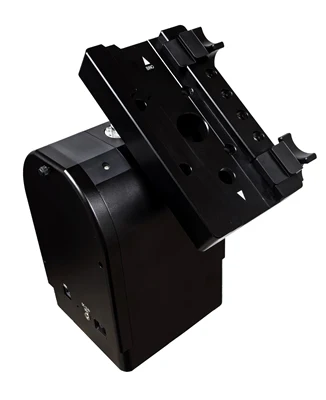
The iOptron HAZ71 is built for the observer who wants the aperture without all of that extra machinery. The mount head weighs just 18.3 lb (8.3 kg) with its saddle installed, yet iOptron rates it for up to 68 lb (31 kg) of payload without a counterweight or counterweight shaft. Both axes use 800:1 strain-wave gearing, giving the HAZ71 the torque needed to carry a substantial telescope while operating intentionally unbalanced.
That makes it a natural home for large refractors, SCTs, Maksutovs, Newtonians, and binocular telescopes. It is an Alt-Az mount, so there is no polar alignment to perform, and built-in GPS, automatic zero-position sensing, GoTo, tracking, and an internal rechargeable battery keep setup remarkably straightforward for a mount capable of carrying this much telescope.
Whether the night is spent resolving a globular cluster with a large SCT, working through double stars, sweeping nebulae with a refractor, studying Jupiter at high power, or observing the Milky Way through a binocular telescope, the idea is the same: the HAZ71 lets you use a serious visual instrument without building the evening around the mount.
Key Features
-
68 lb payload without a counterweight. iOptron rates the HAZ71 for 31 kg (68 lb) of payload while the complete mount head with saddle weighs only 18.3 lb.
-
800:1 strain-wave drives on both axes. High-torque gearing allows the mount to carry an intentionally unbalanced telescope without a conventional counterweight system.
-
Alt-Az GoTo operation. No polar alignment or counterweight balancing is required for normal visual use.
-
Built-in rechargeable battery. An internal 11.1V, 4.4Ah lithium-ion battery lets the mount operate without a power cable running to a battery on the ground.
-
Built-in GPS. The mount acquires location information automatically during setup.
-
Assistant Alignment Wizard. Internal position sensors and GPS allow the mount to establish its zero position and then slew to a bright star for final calibration.
-
Go2Nova 8409 hand controller. Provides a database of approximately 212,000 objects and full standalone operation without requiring a phone or computer.
-
Wi-Fi control. The included 8409 hand controller provides wireless connectivity for compatible applications such as iOptron Commander Lite and SkySafari.
-
Computer control. Supports iOptron Commander and ASCOM on Windows, with third-party INDI support for other platforms.
-
Vixen / Losmandy-D convertible saddle. Accepts either of the two most common astronomical dovetail formats.
-
Dedicated binocular mounting position. The saddle can be moved from the normal side-mounted telescope position to an up-mounted position for large astronomical binoculars.
-
Fast GoTo slewing. Maximum published slew speed is 6° per second in azimuth and 3.6° per second in altitude.
-
Satellite tracking ready. The HAZ71 can work with iOptron's Ultimate Orbit Tracker or compatible third-party software.
-
Electronic friction brakes. Braking on both axes helps bring the mount to a safe stop during a planned or unexpected interruption in power.
-
Automatic zero-position sensing. Built-in magnetic and altitude sensors give the mount a repeatable reference during setup.
- All-metal CNC-machined construction.
- Carrying case included.
-
Two-year limited warranty. The internal rechargeable battery carries a 90-day warranty.
A Different Way to Carry a Big Telescope
The important HAZ71 number is not simply 68 pounds. It is 68 pounds of published payload on an 18.3-pound mount head without a counterweight system.
That changes the practical side of owning a larger visual telescope. A traditional mount capable of handling the same optical tube may also require a counterweight shaft, one or more heavy weights, and substantially more mount hardware before the telescope ever reaches the saddle.
With the HAZ71, the telescope itself becomes most of what you have to carry.
There is an important qualification to the payload figure. iOptron bases the 68 lb rating on the payload's center of gravity being approximately 250mm from the mount's rotation axis. A compact 40 lb SCT and a long 40 lb refractor do not put the same load on the mount.
Tube length, diameter, center of gravity, accessory placement, and wind exposure all matter along with actual weight. A large telescope can therefore be comfortably below the published weight limit and still deserve a particularly rigid tripod or pier because of its geometry.
Counterweight-free does not mean support no longer matters. It means the mount itself no longer needs another heavy mass hanging off the opposite side just to carry the telescope.
Level, Turn It On, and Let It Find the Sky
The HAZ71 avoids the polar-alignment and balancing routines associated with an equatorial mount.
Start with a solid support and level the mount carefully. Secure the telescope and accessories, make sure the tripod or pier is stable, and then power up the system.
The Assistant Alignment Wizard takes over much of the initial setup. The HAZ71 rotates through 360° in azimuth to establish its reference direction, finds its altitude zero position with the telescope pointed toward the zenith, acquires GPS information, and then chooses a bright star for calibration.
Center that star as instructed and the mount is ready for GoTo and tracking.
Because the mount makes a full azimuth rotation during automatic setup, make sure the telescope, diagonal, cables, and accessories have enough clearance before starting the wizard.
If pointing accuracy in another part of the sky needs refinement later in the evening, the 8409 hand controller's Sync to Target function lets you center a known object and improve GoTo performance around that region.
The Internal Battery Matters More Than It Sounds
The HAZ71 contains an 11.1V, 4.4Ah rechargeable lithium-ion battery.
On a rotating Alt-Az mount, eliminating the normal power cable is useful. There is no cord running from the moving mount to a battery on the ground, nothing to wrap around the pier, and one less piece of equipment sitting where someone can trip over it at a star party or outreach event.
The included charger accepts 100–240V AC and supplies 12.6V DC at 2A. The mount can also be powered or charged through its DC input when additional operating time is needed.
iOptron specifies approximately 0.7A power consumption while tracking and 1.7A during GoTo operation. Actual battery runtime will vary with temperature, payload, slewing activity, battery condition, and use.
One Mount, Very Different Telescopes
The HAZ71's capacity makes it useful with instruments that can produce very different observing experiences.
Put a large SCT on it and you have the aperture and focal length for globular clusters, planetary nebulae, smaller galaxies, double stars, lunar detail, and high-power planetary observing. GoTo becomes particularly useful when moving through long lists of smaller deep-sky objects that may otherwise take more time to locate than to observe.
A 5- or 6-inch refractor changes the character completely. Open clusters, sweeping Milky Way fields, nebulae, double stars, and bright deep-sky objects become the emphasis, while the mount still has the tracking precision needed to settle in at higher power on the Moon or planets.
A Maksutov or Maksutov-Newtonian can turn the HAZ71 into a serious high-resolution visual platform without requiring the optical tube to ride on a massive equatorial head. Compact Newtonians can also take advantage of the mount's combination of capacity and easy GoTo operation.
And then there are binocular telescopes.
The HAZ71's saddle can be removed from its normal side-mounted telescope position and installed on top of the adapting plate specifically for large-binocular use. That puts the binocular assembly above the altitude axis and gives it a much more natural observing geometry near the zenith.
A large binocular telescope with automatic GoTo and tracking is a very different experience from manually moving a heavy binocular assembly from object to object. Open clusters, dark nebulae, Milky Way star fields, emission nebulae, and large deep-sky structures become targets you can spend time studying instead of continually repositioning the instrument.
Under the Night Sky
The best way to understand the HAZ71 is not to assign it one kind of target. Its strength is letting a large visual telescope do whatever that telescope is good at while the mount handles finding and following the object.
With a large SCT, M13 can resolve into a dense swarm of stars while M57 sits steady in the field long enough to study its uneven ring. Galaxies such as M81, M82, M51, and brighter members of the Virgo Cluster become practical stops in a long GoTo observing session. Small planetary nebulae and double stars are particularly enjoyable when you can move from one high-power target to the next without repeatedly finding and recentering them.
With a large refractor, the Double Cluster, Pleiades, Veil Nebula, brighter emission nebulae, and sweeping star fields take over. Put a suitable filter in the diagonal and spend time tracing faint nebular structure while the mount keeps the field stationary.
At high power, the same tracking becomes just as useful on Jupiter, Saturn, Mars, or the Moon. Instead of nudging the telescope every few seconds, you can wait for brief moments of steadier seeing while the object remains in the center of the eyepiece.
For outreach, that tracking can be even more valuable. Once an object is centered, visitor after visitor can step to the eyepiece without someone having to reposition the telescope after every person in line.
And with a large binocular telescope, the HAZ71 becomes a GoTo tour of the Milky Way: one cluster, nebula, or rich star field after another, seen with both eyes and kept centered while you actually spend time looking.
Visual First, But Not Visual Only
The HAZ71 is fundamentally an Alt-Az mount, and that determines what kinds of imaging make sense.
Lunar and planetary imaging are natural applications because those techniques generally record video or large numbers of very short exposures. The mount's job is to keep the target on the sensor while the camera collects frames, and owners have successfully used the HAZ71 for planetary imaging at focal lengths around 3,000mm.
Solar imaging with a properly equipped solar telescope follows the same principle, and short-exposure electronic-assisted astronomy and live stacking can also be useful with brighter deep-sky targets.
Traditional long-exposure deep-sky astrophotography is different. Because the HAZ71 tracks in altitude and azimuth, the orientation of the sky slowly rotates relative to the camera during tracking. That field rotation becomes increasingly visible as individual exposures get longer.
If multi-minute guided exposures of galaxies and nebulae are part of the plan, an equatorial mount is the appropriate tool. Within iOptron's strain-wave family, an HAE69 is the more versatile direction when both substantial payload capacity and equatorial imaging are required.
That does not make imaging on the HAZ71 limited to three objects in the sky. It simply means its imaging strengths are the kinds of work that suit an Alt-Az platform: lunar, planetary, solar, short-exposure EAA, live stacking, and similar applications.
From the Cloudy Nights Community
HAZ71 owners have already used the mount with a broad range of substantial optical systems rather than treating it as a dedicated planetary platform.
One owner has used the mount visually and for lunar and planetary imaging at approximately 3,000mm focal length and reported that keeping a small camera region centered was not a problem. Another uses a roughly 44 lb, 52-inch-long 8-inch f/6 Maksutov-Newtonian on a Tri-Pier for both visual observing and high-resolution imaging. :chatgpt-content-reference{index="3"}
Those reports are useful less as performance guarantees than as examples of the kind of equipment the HAZ71 attracts: substantial telescopes whose owners want high-capacity Alt-Az operation without the weight and setup of a conventional equatorial system.
Owners also repeatedly emphasize support and leveling. A mount that weighs 18.3 lb but carries a much heavier telescope still needs a rigid foundation, particularly when the optical tube is long or the observing magnification is high.
Choosing a Tripod or Pier
The HAZ71 deserves more support than the lighter HAZ mounts.
iOptron specifically does not recommend its lightweight 8061A carbon-fiber tripod for the HAZ71. The company's current HAZ71 combinations instead pair the mount with the LiteRoc tripod #8023ACC and #8043 MiniPier, or with the #8034 Tri-Pier and #8043 MiniPier.
For a moderate telescope and a system that still needs to travel easily, the LiteRoc combination keeps the setup reasonably portable.
For a heavy SCT, long refractor, large Maksutov-Newtonian, or any configuration being used regularly at high magnification, the Tri-Pier provides a more substantial base.
The MiniPier also adds useful clearance between the telescope and the tripod or pier. That becomes increasingly important with long optical tubes, large diagonals, and rear-mounted accessories when the telescope points high in the sky.
Park It and Come Back Later
The HAZ71 can retain its alignment information between observing sessions when the mount is properly parked and left physically undisturbed.
The hand controller offers several parking positions, including horizontal, zenith, and current-position choices. When the mount is parked before shutdown, its alignment information and reference points are retained.
If the tripod or pier remains in place and the mount is not moved, that can save setup time when you return later the same night or on another session.
If the mount or support is moved, perform the normal alignment procedure again.
What's Included
- iOptron HAZ71 strain-wave Alt-Az GoTo mount head
- Built-in 11.1V, 4.4Ah rechargeable lithium-ion battery
- Convertible Vixen / Losmandy-D dovetail saddle
- Go2Nova 8409 hand controller
- 6P6C coiled hand-controller cable
- USB cable for computer control and firmware updates
- 100–240V AC / 12.6V 2A battery charger for indoor use
- Carrying case
Not included: tripod, Tri-Pier, or MiniPier.
Frequently Asked Questions
How much does the HAZ71 weigh?
The mount head weighs 18.3 lb (8.3 kg) with its dovetail saddle installed.
How much can the HAZ71 carry?
iOptron rates it for up to 68 lb (31 kg). That rating assumes the payload's center of gravity is approximately 250mm from the mount's rotation axis, so telescope length, diameter, and geometry matter along with total weight.
Does the HAZ71 need a counterweight?
No. It is designed to operate without a conventional counterweight or counterweight shaft.
Does it require polar alignment?
No. The HAZ71 is an Alt-Az mount, so there is no polar axis to align.
Does it have a built-in battery?
Yes. The mount contains an 11.1V, 4.4Ah rechargeable lithium-ion battery. The mount carries a two-year limited warranty and the battery carries a 90-day warranty.
Does it have GPS?
Yes. GPS is built into the mount and is used during automatic setup.
Does it have Wi-Fi?
Yes. Wireless connectivity is provided through the included Go2Nova 8409 hand controller.
How fast does it slew?
iOptron specifies a maximum slew speed of 6° per second in azimuth and 3.6° per second in altitude.
Can I control the HAZ71 from a phone or tablet?
Yes. Compatible applications such as iOptron Commander Lite and SkySafari can communicate with the mount through the 8409 hand controller's Wi-Fi connection.
Can it carry a C14?
A bare C14 optical tube is below the HAZ71's published 68 lb payload rating, but that does not tell the whole story. A C14 is a large-diameter telescope and the complete visual or imaging configuration adds a diagonal, eyepiece or camera, finder, dew equipment, and other accessories. The 250mm center-of-gravity assumption and support system should be considered carefully. For a telescope of this size, we would use a substantial pier and look at the complete configuration rather than the OTA weight alone.
Can it carry a 6-inch refractor?
Many 6-inch refractors fall within the published weight limit, but long refractors create more leverage than compact telescopes of the same weight. Tube length, rings, diagonal, eyepiece, center of gravity, wind exposure, and tripod or pier stiffness all matter. The HAZ71 has the capacity for serious refractors, but the support underneath it becomes increasingly important as the tube gets longer.
Is it good for large binocular telescopes?
Yes. Large-binocular mounting is an intended part of the HAZ design. The saddle can be moved from its normal side-mounted telescope position to the top of the adapting plate for binocular use.
Can the HAZ71 do astrophotography?
It is well suited to lunar, planetary, and solar imaging and can also be useful for short-exposure EAA and live stacking. It is not intended for conventional long-exposure deep-sky imaging because Alt-Az tracking produces field rotation over time.
Can I observe galaxies and nebulae with the HAZ71?
Absolutely. The mount does not determine what you can observe visually; the telescope does. A large SCT, refractor, Newtonian, or binocular telescope on the HAZ71 can be used for galaxies, nebulae, clusters, double stars, the Moon, planets, and essentially any visual target appropriate for that instrument.
HAZ46 or HAZ71?
The HAZ46 weighs 12.3 lb and carries up to 44 lb, making it the more portable choice for many medium-size visual systems. The HAZ71 increases the payload rating to 68 lb on an 18.3 lb head and is intended for larger or more mechanically demanding telescopes. Choose between them based on the complete telescope's weight, length, center of gravity, and support requirements rather than aperture alone.
HAZ71 or HAE69?
The HAZ71 is a dedicated Alt-Az mount designed around simple visual setup, an internal battery, large-binocular compatibility, and high payload capacity without counterweights. The HAE69 can operate in either equatorial or Alt-Az mode and is the better direction when conventional long-exposure deep-sky imaging is also required.
What tripod or pier should I use?
iOptron currently lists the LiteRoc tripod #8023ACC with the #8043 MiniPier or the #8034 Tri-Pier with the #8043 MiniPier. The HAZ manual specifically advises against using the lighter 8061A carbon-fiber tripod with the HAZ71.
Will it remember its alignment after being turned off?
The mount can preserve alignment information when it is properly parked and remains physically undisturbed between sessions. If the mount or support is moved, perform the normal alignment procedure again.
Accessories
iOptron Tri-Pier #8034 with #8043 MiniPier (sold separately): the more substantial support choice for heavy SCTs, long refractors, Maksutov-Newtonians, and other demanding HAZ71 payloads.
iOptron LiteRoc Tripod #8023ACC with #8043 MiniPier (sold separately): a more portable HAZ71 support combination for telescope systems that do not require the additional mass and rigidity of the Tri-Pier.
iOptron iMate Astronomy Control Box (sold separately): provides an onboard INDI-based computer for users who want networked control of the mount and compatible astronomy equipment.
Final Thoughts
The HAZ71 is for the observer who wants to use a large telescope without making the mount the largest part of the project.
Its 18.3 lb head can carry up to 68 lb of payload without a counterweight, while built-in GPS, automatic setup, GoTo, tracking, and an internal rechargeable battery remove much of the equipment and routine that normally come with a mount in this capacity class.
That can mean a 6-inch refractor on open clusters and nebulae, a large SCT on galaxies and globular clusters, a Maksutov or Mak-Newt at high power, a substantial Newtonian working through deep-sky objects, or a binocular telescope sweeping the Milky Way. The HAZ71 does not dictate what kind of visual observer you need to be; it gives a much larger telescope an easier mount to live on.
It is not intended to replace an equatorial mount for traditional long-exposure deep-sky astrophotography. That is simply a different job. The HAZ71 is about making visual astronomy, outreach, high-resolution imaging, short-exposure electronic observing, and large-binocular use easier with telescopes that normally demand considerably more mount underneath them.
The point of the HAZ71 is not that it makes a big telescope small. It makes owning and using a big telescope less of a production.
Tech Details:
| Mount Type |
Strain wave alt-azimuth GoTo mount head |
| Altitude / Azimuth Gear System |
Strain wave gear, both axes |
| Reduction Ratio |
800:1 (both axes) |
| Payload |
68 lb (31 kg), no counterweight* |
| Mount Weight |
18.3 lb (8.3 kg) with dovetail saddle |
| Payload / Mount Weight |
3.73 |
| Drive Motor |
Stepper motor |
| Structure |
All metal, CNC machined, black anodized |
| Level Indicator |
Bubble level |
| GPS |
Built-in |
| Battery |
Built-in rechargeable Li-ion, 11.1V, 4.4Ah |
| Battery Charger |
100–240V AC input / 12.6V DC 2A output, 5.5/2.1 mm plug (indoor use) |
| Power Consumption |
0.7A tracking, 1.7A GoTo |
| Hand Controller |
Go2Nova 8409, ~212,000-object database |
| Control System |
Go2Nova / iOptron Commander |
| Communication |
Wi-Fi and USB (via hand controller); ASCOM (Windows), INDI (macOS/Linux/Raspberry Pi), iMate (via INDI), SkySafari, iOptron Commander Lite |
| Tracking |
Automatic; satellite tracking with third-party software |
| Maximum Slew Speed |
6°/sec azimuth, 3.6°/sec altitude |
| Power-Off Brake |
Electronic friction brake |
| Dovetail Saddle |
Vixen / Losmandy-D dual; top or side position |
| Mounting Base |
3/8-16 threaded hole |
| Tripod / Pier |
Optional: LiteRoc tripod #8023ACC with #8043 MiniPier, or Tri-Pier #8034 |
| Firmware |
Upgradable |
| Case |
Carrying case (included) |
| Operating Temperature |
−20 °C to 40 °C |
| Shipping Weight / Box |
29 lb; 17 × 15 × 9 in |
| Warranty |
Two year limited (battery 90 days) |
| Product Code |
HZ712 |
| *Payload Note |
Rated with payload center of gravity 250 mm from the rotation axis |