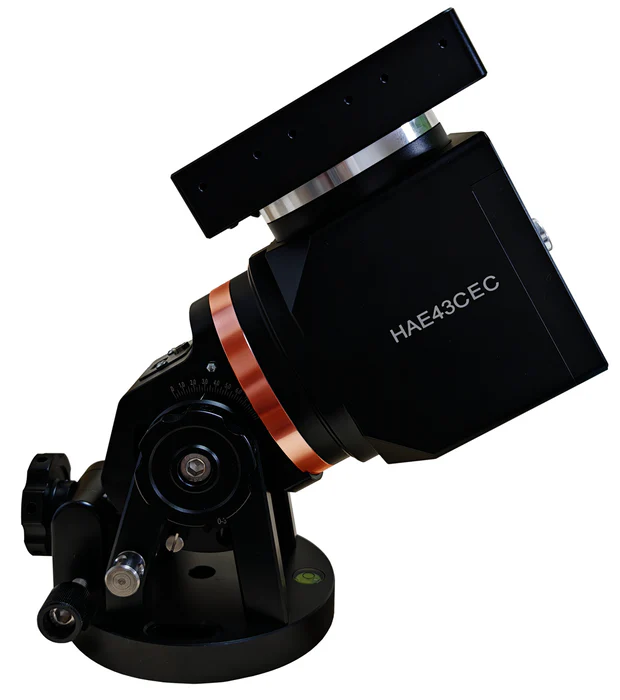
The iOptron HAE43C-EC takes the 44-pound counterweight-free capacity of the HAE43C and adds a high-precision encoder to the right-ascension axis. For an imager, that encoder is the reason to step up to the EC version.
The mount head weighs just 12.6 lb (5.7 kg), yet iOptron rates it to carry 44 lb (20 kg) without a counterweight and up to 55 lb (25 kg) with the optional counterweight system. Strain-wave gearing on both axes provides the compact size and high torque, while the RA encoder works with iOptron's Real-Time Periodic Error Correction to continuously reduce tracking error before an external guider ever sees it.
Built-in Wi-Fi and USB-C control mean a hand controller is optional, not required. The HAE43C-EC also operates in either equatorial or Alt-Az mode, accepts both Vixen and Losmandy-D dovetails, and arrives in an aluminum carrying case. It is a substantial imaging mount that still remains easy to move when better skies are somewhere other than your backyard.
Features
-
High-precision RA encoder with Real-Time PEC. The encoder continuously monitors right-ascension motion and allows the mount to correct much of the tracking error produced by the strain-wave drive in real time.
-
44 lb counterweight-free payload. Carry up to 20 kg (44 lb) without a conventional counterweight shaft and weights.
-
Up to 55 lb with a counterweight. Add the optional counterweight system when a heavier or more demanding telescope configuration calls for additional capacity.
-
Only 12.6 lb for the mount head. A payload-to-mount-weight ratio of approximately 3.5:1 before a counterweight is added.
-
Strain-wave gearing on both axes. The RA axis uses a 640:1 reduction and DEC 480:1, providing high torque from a compact drive system.
-
270-second RA gear period. The high-precision encoder and Real-Time PEC work directly with the tracking behavior of the strain-wave RA drive.
-
Equatorial and Alt-Az operation. Use EQ mode for astrophotography and tracking or configure the same mount in Alt-Az mode for visual observing.
-
Built-in Wi-Fi. Control the mount wirelessly from compatible phones, tablets, and astronomy software without requiring a handset.
-
Direct USB-C computer control. Connect directly to a computer using iOptron Commander and ASCOM on Windows or compatible third-party INDI software on other platforms.
-
Optional Go2Nova hand controller. iOptron's 8411 OLED handset can be added if you prefer physical controls and standalone GoTo operation.
-
Dual Vixen/Losmandy-D saddle. Accepts both common telescope dovetail standards without requiring a replacement saddle.
-
Integrated ST-4 autoguider port. Traditional autoguiding remains available in addition to software-based guiding through a computer.
-
Electronic friction brake. Designed to stop mount movement safely during a planned or unexpected interruption in power.
-
Automatic zero-position search. Built-in sensing allows the mount to locate its reference position electronically.
-
Optional external iPolar. Add iOptron's electronic polar-alignment camera when you want a dedicated polar-alignment solution.
-
Aluminum carrying case included. A fitted case protects the mount during transport and makes sense for a system designed around portability.
What the Encoder Changes
Strain-wave gearing is exceptionally good at putting a large amount of torque into a small mount, but its tracking error behaves differently from the comparatively smooth periodic error of a traditional worm drive.
The HAE43C-EC adds a high-precision encoder to the RA axis and uses iOptron's Real-Time Periodic Error Correction to continuously monitor and correct that motion.
Instead of waiting for an external guide camera to detect that the RA axis has moved away from where it should be, the mount already has a second source of information measuring the axis itself. That gives the imaging system a smoother tracking platform to begin with.
iOptron says the resulting accuracy is sufficient that many users may choose to image without guiding. Whether that makes sense for your particular system still depends on focal length, pixel scale, exposure time, polar alignment, and how demanding you are about star shape.
With a shorter or more forgiving image scale, encoder-assisted unguided imaging may be practical. At longer focal lengths and finer image scales, guiding can still provide the additional correction required for consistently good long exposures.
The important point is not that the encoder makes guiding obsolete. It is that the RA axis is already correcting itself before the guider enters the picture.
44 Pounds Without Counterweights
The encoder gets much of the attention on the EC model, but the basic HAE43 platform remains impressive on its own.
A 12.6 lb mount head is rated to carry 44 lb without counterweights. That leaves room for a telescope, cooled camera, filter wheel, electronic focuser, guide system, rotator, and the other equipment that begins accumulating around a serious imaging rig.
Add the optional counterweight system and the rated capacity increases to 55 lb.
There is an important qualification to those numbers. iOptron bases its payload rating on the center of gravity being approximately 200mm from the RA rotation axis. A compact 35-pound SCT or astrograph and a long 35-pound refractor do not place the same load on the drive.
That makes telescope geometry just as important as scale weight. Compact astrographs, SCTs, and reasonably sized refractors play particularly well to the HAE43C-EC's strengths. As the tube becomes longer and the moment arm increases, leaving additional margin below the published payload becomes increasingly sensible.
The optional counterweight is there when a particular configuration benefits from one. Counterweight-free is a capability, not a rule.
Guiding an Encoder Mount
The EC version can also change the way you approach guiding.
On a non-encoder strain-wave mount, relatively frequent guide corrections are commonly used because the guider has to follow the drive's tracking error directly. The HAE43C-EC is already correcting RA internally through the encoder and Real-Time PEC.
That means there is no reason to assume the fastest possible guide cadence is automatically the best one.
Seeing conditions, guide-camera sensitivity, focal length, image scale, DEC behavior, guiding software, and the telescope itself all influence the optimum settings. Some imaging systems may work well with slower RA corrections that allow the encoder to do more of the work. Others may respond better to a somewhat faster cadence.
The best guide setting is the one that produces the best actual images. Round stars and consistent FWHM in your subframes matter more than chasing the smallest possible RMS number on a graph.
From the Cloudy Nights Community
Experience from HAE43EC and HAE43C-EC owners on Cloudy Nights provides some useful perspective on what the encoder can realistically do.
Owners generally report that the encoder substantially reduces the raw RA tracking error of the strain-wave drive. One owner using both HAE29EC and HAE43EC mounts described the encoder as largely invisible in normal operation after initial calibration and reported excellent results with the HAE43EC carrying a 10-inch RC.
That same owner made an important point: the encoder tames the strain-wave periodic error rather than making it disappear completely. He continued to guide and favored a slower guiding cadence than he would use with a non-encoder harmonic mount.
Other HAE43C-EC users have found that their systems respond better to somewhat quicker corrections, particularly while working through DEC backlash, guiding configuration, and longer focal lengths. That variation is exactly why copying another owner's guide settings rarely gives the whole answer.
There are also examples of owners initially struggling with guiding and later getting much better performance after working through PHD2 settings, DEC behavior, telescope position, and the rigidity of the pier or tripod. The encoder improves the RA tracking platform, but the telescope, support, guide system, software, seeing, and setup still matter.
The useful takeaway from the community is straightforward: buy the EC version for better RA tracking, not because you expect every imaging system to become permanently unguided. Let the encoder do its job, add guiding when your image scale benefits from it, and judge the mount by the stars in the finished exposures.
Control It the Way You Want
The HAE43C-EC has its main control electronics built into the mount, so a hand controller is no longer required simply to operate it.
Connect directly through USB-C for a software-driven imaging setup. Windows users can work through iOptron Commander and ASCOM, while compatible INDI software provides control options on other platforms.
Built-in Wi-Fi also allows wireless operation from compatible smartphones and tablets using iOptron Commander Lite or applications such as SkySafari.
If you prefer physical controls at the telescope, iOptron's optional 8411 Go2Nova OLED handset provides standalone GoTo operation.
That gives the HAE43C-EC considerable flexibility. It can sit underneath a fully automated imaging computer one night and operate as a visual GoTo mount with a handset the next.
EQ for Imaging, Alt-Az for Visual
The HAE43C-EC can operate in either equatorial or Alt-Az mode.
In equatorial mode, polar alignment provides the geometry required for long-exposure astrophotography. The encoder, Real-Time PEC, and optional guiding then handle the tracking side of the system.
Switch to Alt-Az mode and the same mount becomes a high-capacity GoTo platform for visual observing without requiring a normal polar-alignment routine.
That is particularly useful on a mount with this much capacity. A substantial refractor or SCT that spends one night collecting camera data can spend the next pointed at the Moon, planets, double stars, or deep-sky objects with an eyepiece.
What's Included
- iOptron HAE43C-EC strain-wave AZ/EQ mount head
- High-precision RA encoder with Real-Time PEC
- Dual Vixen/Losmandy-D dovetail saddle
- 12V AC/DC power adapter for indoor use
- USB-C computer/firmware cable
- Aluminum carrying case
Available separately: Go2Nova 8411 OLED hand controller, external iPolar electronic polar scope, LiteRoc tripod, Tri-Pier, counterweight shaft and counterweight, MiniPier extension, and other compatible accessories.
Frequently Asked Questions
What does the EC version add to the standard HAE43C?
The HAE43C-EC adds a high-precision encoder to the right-ascension axis along with iOptron's Real-Time Periodic Error Correction. The payload, dual strain-wave architecture, saddle, Wi-Fi, USB-C control, and other major mechanical features remain essentially the same.
Does the encoder eliminate periodic error?
It substantially reduces the effect of the RA drive's tracking error, but it should not be thought of as making the mount mathematically perfect. The encoder continuously measures axis movement and allows the control system to correct much of that error in real time.
Can I image without guiding?
Potentially. iOptron says the encoder provides sufficient tracking accuracy that many users may choose to image unguided. How practical that is depends on focal length, pixel scale, exposure length, polar alignment, and your requirements for star shape. More demanding imaging systems may still benefit from guiding.
Should I guide it differently from the standard HAE43C?
Possibly. The RA encoder is already making corrections internally, so the fast guide cadence often used with a non-encoder strain-wave mount is not automatically the best choice. Tune the guider to your actual telescope and imaging results.
How much can the HAE43C-EC carry?
iOptron rates it for 44 lb (20 kg) without a counterweight and up to 55 lb (25 kg) with the optional counterweight system. The rating assumes the payload center of gravity is approximately 200mm from the RA axis, so telescope geometry matters in addition to total weight.
Does it require a hand controller?
No. The current HAE43C-EC has its control electronics built into the mount and can be operated through USB-C or built-in Wi-Fi. The 8411 Go2Nova OLED hand controller is optional.
Does it include iPolar?
No. The current HAE43C-EC accepts iOptron's external iPolar electronic polar scope as an optional accessory. Software-based polar-alignment routines can also be used.
Does it include iMate?
No. The HAE43C-EC is the encoder-equipped C model. If you want the HAE43 with both the RA encoder and iOptron's integrated iMate computer, that is the HAE43B-EC.
Can I use it for visual observing?
Yes. The mount can operate in Alt-Az mode for visual use as well as equatorial mode for astrophotography.
Final Thoughts
The HAE43C-EC is for the imager who likes the portability and capacity of the standard HAE43C but wants another level of control over RA tracking.
You still get the feature that makes the HAE43 platform unusual: 44 pounds of counterweight-free payload in a mount head weighing only 12.6 pounds. The EC version adds a high-precision encoder and Real-Time PEC to continuously correct the right-ascension axis while the mount tracks.
That can make unguided imaging practical with appropriately forgiving systems and give a guider a better starting point when focal length and image scale become more demanding.
Built-in Wi-Fi and USB-C keep the control side flexible, the optional handset lets it work as a conventional visual GoTo mount, and Alt-Az operation means it doesn't have to live exclusively underneath a camera.
If you want the HAE43's carrying capacity and portability but the onboard iMate computer isn't part of your workflow, the HAE43C-EC is the encoder-equipped version that keeps the rest of the system in your hands.